



Many business owners face high taxes, complex rules, and limited control in their home countries. These challenges make it difficult to protect assets or expand across borders.
An offshore company set up in Dubai offers a solution. In 2026, Dubai remains a leading choice due to full foreign ownership, zero income tax, and a strong legal system. With options such as JAFZA and RAK ICC, companies can trade globally, hold assets, and manage investments, all without a physical office in the UAE.
What is an Offshore Company?
An offshore company is a type of legal business set up under a special offshore jurisdiction. It is registered in the UAE but is not permitted to conduct business within the UAE. Its main purpose is to:
Carry out business activities outside the UAE
Hold and manage assets
Protect wealth and reduce operating costs
Control shares in other companies
These companies are mainly used for international operations. They do not require office space, local employees, or residence visas.
Here is how an offshore company differs from other business types in Dubai:
Feature | Offshore Company | Free Zone Company | Mainland Company |
Business inside the UAE | Not allowed | Allowed in the Free Zone only | Allowed across the UAE |
Local office required | No | Optional | Yes |
UAE visa eligibility | No | Yes | Yes |
Foreign ownership | 100% | 100% | Allowed in most sectors |
Use case | International only | Local & international | Full UAE market access |

Key Benefits of Offshore Business Setup in Dubai
Setting up an offshore company in Dubai offers several clear advantages. These benefits support international operations, reduce operating costs, and provide business owners with full control and flexibility.
100% Foreign Ownership
An offshore company allows the owner to hold 100% of the company shares without a local partner or sponsor. Full foreign ownership gives the investor complete control over the company’s decisions and profits. There are no restrictions on the owner’s nationality, and the ownership structure can be customised for a single person or a group.
Tax Exemptions and Profit Repatriation
Offshore companies in Dubai benefit from zero corporate tax, zero income tax, and no withholding tax on profits. These tax advantages apply as long as the company does not conduct business in the UAE market.
In addition, all profits can be repatriated in full to the owner’s home country or any other country. There are no restrictions on capital movements, which gives the owner complete freedom to manage earnings and expenses across borders.
Privacy and Confidentiality
Dubai’s offshore jurisdictions, such as JAFZA and RAK ICC, offer strong privacy laws. The names of shareholders and directors are not made public. Company documents and personal data are held securely and are not listed in any public register.
This level of confidentiality is useful for asset protection, estate planning, or when managing investments through holding companies. It ensures that ownership details remain private while meeting all legal and compliance requirements.
No Physical Office Requirement
Offshore companies are not required to have a physical office space in Dubai or elsewhere in the UAE. There is also no need to hire local employees or rent premises. The absence of office and staffing requirements reduces operational costs and makes compliance easier.
All setup and communication can be handled through a registered agent, who serves as the local point of contact. This structure is suitable for businesses that do not need a physical presence in the UAE.
Access to Multi-Currency Bank Accounts
Once an offshore company is formed, it can open a corporate bank account in Dubai or other international financial centres. These accounts support multiple currencies, which is essential for managing international transactions, paying suppliers, and receiving income.
Banks in Dubai follow international security and compliance standards and offer online banking for easy access. Offshore companies must meet the bank’s due diligence and documentation requirements, but once approved, they can manage funds globally without limits on currency or country.
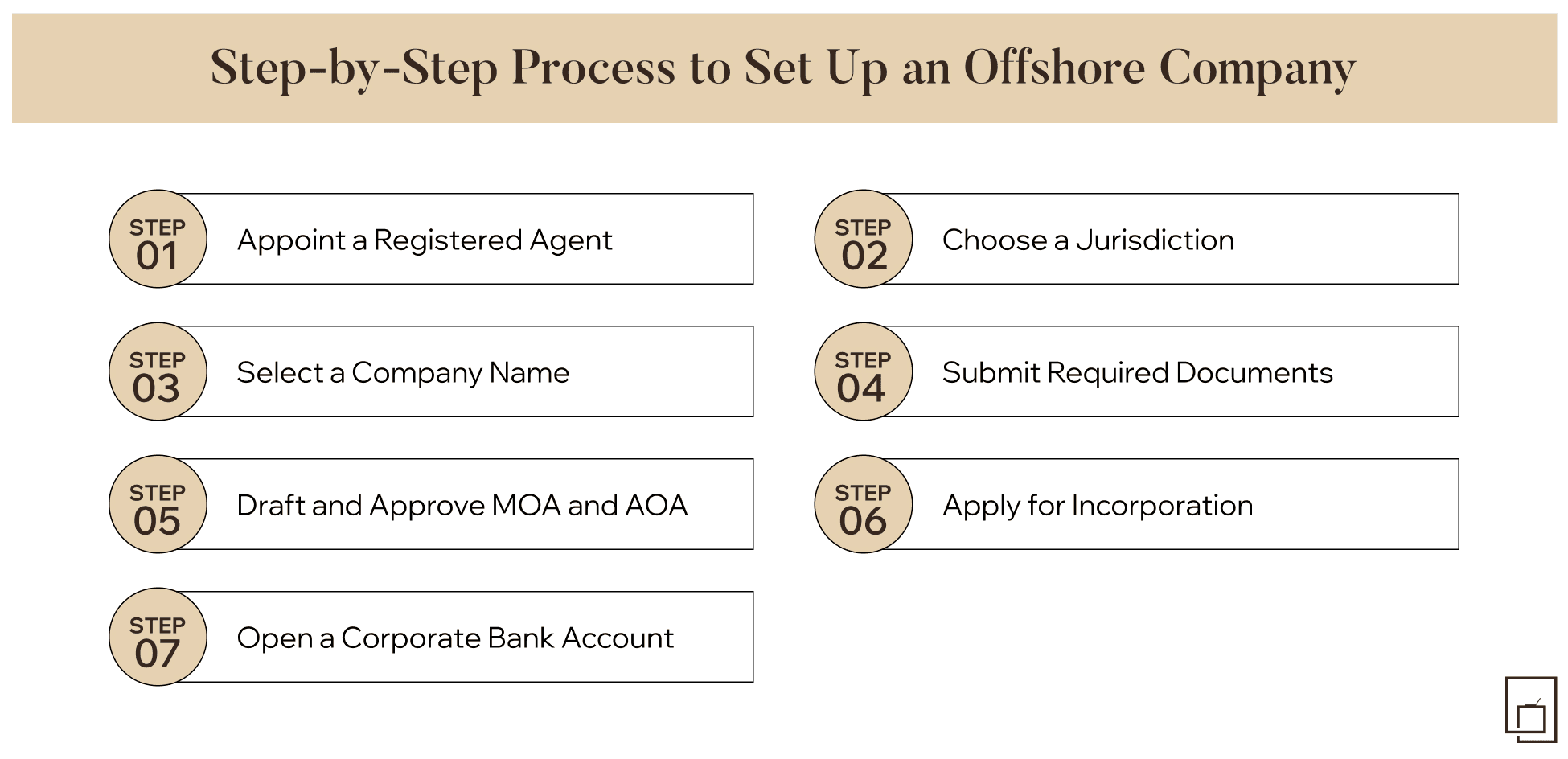
Step-by-Step Process to Set Up an Offshore Company
Setting up an offshore company in Dubai involves a structured process that must follow the rules of the selected offshore jurisdiction. Below is a clear and detailed breakdown of each step involved.
Step 1: Appoint a Registered Agent
Offshore companies in the UAE can only be formed through an approved registered agent. An approved registered agent is a licensed service provider that manages the business owner's setup. The agent prepares the documents, files the application, and communicates with the authorities.
Choosing a registered agent is a legal requirement. The company cannot be registered directly with the government without an agent.
Step 2: Choose a Jurisdiction
The UAE offers a few key offshore jurisdictions, each with its own rules and features. The most commonly used are:
Jebel Ali Free Zone (JAFZA Offshore)
Ras Al Khaimah International Corporate Centre (RAK ICC)
Ajman Free Zone Offshore
The choice depends on factors such as cost, activity type, preferred location, and banking needs. The registered agent will guide you in selecting the most suitable option.
Step 3: Select a Company Name
The business owner must select a unique company name that complies with the jurisdiction's rules. The name:
Must not be the same as an existing company
Cannot include certain restricted words (e.g., "bank", "insurance", "government")
Must end with the correct legal suffix (e.g., "Ltd" or "Limited")
The registered agent will check name availability and reserve the approved name.
Step 4: Submit Required Documents
The following documents must be submitted for approval:
For individual shareholders and directors:
Valid passport copy
Proof of residential address (utility bill or bank statement)
Personal CV or professional background
Completed application form
For corporate shareholders:
Certificate of Incorporation
Board Resolution approving the offshore setup
Memorandum and Articles of Association of the parent company
Company structure chart
All documents must be in English and may need to be notarised or attested, depending on the jurisdiction’s rules.
Step 5: Draft and Approve MOA and AOA
Two key legal documents must be prepared and approved:
Memorandum of Association (MOA) – outlines the company’s objectives and powers
Articles of Association (AOA) – sets the rules for internal management
These documents define how the company will operate. The registered agent usually prepares these templates based on the business type and jurisdiction.
Step 6: Apply for Incorporation
Once the documents are ready and signed, the registered agent will submit the full application to the offshore authority. This includes:
Application form
Approved company name
Identity documents
MOA and AOA
Payment of setup fees
If everything is in order, the offshore authority will issue the Certificate of Incorporation, confirming the company's official registration.
Step 7: Open a Corporate Bank Account
After the company is registered, the next step is to open a business bank account. The company can apply to local or international banks that accept offshore clients.
To open the account, the bank will request:
Certificate of Incorporation
MOA and AOA
Passport copies and proof of address for shareholders
Company structure and business plan
Banks conduct their own checks before approving an account. Once approved, the offshore company can begin international transactions and manage funds in multiple currencies.

Regulatory Considerations and Compliance in 2026
Offshore companies in Dubai must comply with specific rules to remain compliant with both UAE laws and international standards. These rules are designed to prevent illegal activities, such as money laundering, and to ensure that offshore structures are used for legitimate business purposes.
Below are the key compliance areas to consider in 2026.
Economic Substance Requirements
Some offshore companies may need to show economic substance in the UAE. Economic substance requires the company to prove that it engages in real business activities related to its stated purpose. The requirement applies if the company operates in certain sectors, such as:
Holding company activities
Shipping
Intellectual property
Finance and leasing
Service centres or headquarters
If economic substance is required, the company may need to:
Have a registered office or workspace in the UAE
Hire qualified employees based in the UAE
Keep records of key business decisions made within the country
Companies must submit an annual Economic Substance Report to the relevant authority if their activity falls under these rules.
Anti-Money Laundering (AML) and Know Your Customer (KYC)
All offshore companies in Dubai are required to follow the UAE’s Anti-Money Laundering (AML) and Know Your Customer (KYC) laws. These are in place to prevent financial crimes and ensure transparency.
To comply, offshore companies must:
Provide full and accurate information about their owners and business activities
Keep financial records and company documents for at least five years
Notify the authorities of any suspicious transactions or changes in company structure
Cooperate with audits or checks by regulatory bodies if requested
Registered agents are also responsible for collecting and verifying this information before submitting company applications.
Ultimate Beneficial Owner (UBO) Disclosure
The UAE requires all offshore companies to identify and record their Ultimate Beneficial Owners (UBOs). A UBO is the person who ultimately owns or controls the company, even if ownership is held through another company.
UBO details must be:
Recorded in the company’s internal register
Submitted to the offshore authority when requested
Kept up to date on any changes
This requirement improves transparency and ensures that offshore companies are not used to hide the identity of real owners.
Annual Renewals and Ongoing Obligations
Once formed, offshore companies must:
Renew the company licence every year through the registered agent
Pay annual government and service fees
Maintain accurate records, including financial statements and meeting minutes
Update authorities if there are changes in shareholders, directors, or company activities
Failure to meet these requirements may result in fines, licence cancellation, or legal penalties.




Frequently Asked Questions
Is the oil business profitable in Dubai?
Do I need a local partner?
How long does it take to set up?
Can I get a visa with an offshore company?
Can a foreigner set up a company in Dubai?