


Key Takeaways
Mainland, Free Zone, and Offshore structures do not appear within the same public databases.
An active company status does not confirm tax standing, sector approvals, or Ultimate Beneficial Ownership.
Recent amendments and renewals do not always appear immediately across searchable systems .
Activity classifications determine what a company is permitted to invoice, supply, or contract under.
Procurement reviews, banking checks, and Ejari registration all rely on accurate filing status.
Business verification checks have become routine across the UAE before supplier onboarding, procurement approvals, lease registration, and corporate banking reviews. The process itself is relatively simple. The difficulty usually comes from understanding which authority holds the relevant records, particularly where Mainland and Free Zone jurisdictions operate through entirely separate systems.
That distinction affects more than the lookup itself. The gap between what appears within searchable systems and what remains undisclosed often shapes how counterparties assess risk before moving forward.
What Does a Trade Licence Check Show?

Licence Status and Commercial Standing
A business lookup typically returns one of several classifications: Active, Expired, Suspended, Cancelled, or Under Renewal. Each signals a different level of commercial risk.
An entity listed as Under Renewal may still fall within an approved grace period, yet banks and procurement teams often treat the filing cautiously until renewal is completed. Suspended records are also frequently misunderstood. In many cases, they reflect unresolved fines, failed inspections, or ongoing regulatory disputes rather than a simple administrative delay.
For counterparties reviewing a supplier or contractor, the distinction matters because the status itself can affect onboarding, payment approvals, and banking reviews long before formal cancellation occurs.
Registered Activities and Commercial Scope
UAE trade licences classify permitted functions through ISIC Rev.4 activity codes, which define the categories a company is allowed to invoice, supply, or contract under.
A management consultancy billing for IT hardware procurement, for example, falls outside its designated classification. That mismatch may trigger AML review flags during banking transactions or raise concerns during supplier due diligence procedures.
Reviewing the authorised scope alongside the filing status provides a clearer indication of whether the company is permitted to carry out the work being contracted.
Legal Entity Details and Expiry Records
Corporate records typically display the registered trade name, issuing authority, expiry date, and jurisdiction. These details are not always straightforward. Commercial names may differ from the underlying legal entity, while branch offices are listed separately from parent companies. Firms that have transferred jurisdictions can also appear under earlier filings.
One important limitation is ownership visibility. Public directories do not disclose Ultimate Beneficial Ownership structures, and shareholder details available through standard searches are often incomplete.
Where a filing is close to expiry or has recently lapsed, reviewing trade licence renewal requirements in Abu Dhabi or the renewal process in Dubai helps clarify the timelines and documentation involved before agreements move forward.
How to Perform a Dubai Trade Licence Check
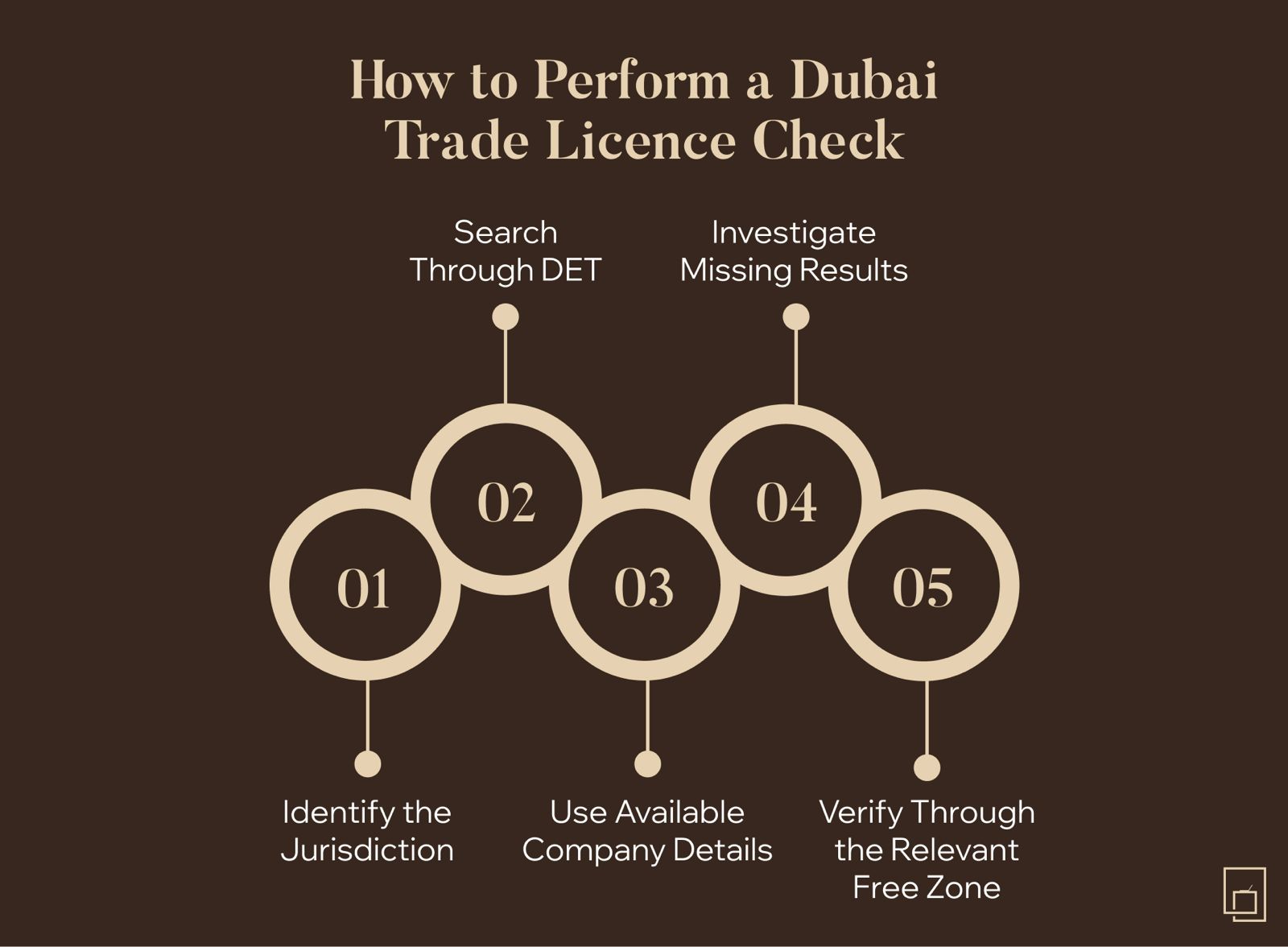
Search Mainland Records Through DET
The Department of Economy and Tourism provides the primary lookup platform for Dubai Mainland companies. Searches can be performed using a licence number, trade name, or approved activity classification. DET data also feeds into the UAE Unified National Economic Register, giving the system broader cross-emirate coverage than most standalone authority databases.
Arabic trade names are translated phonetically into English within the system. Searching the distinctive root of a name, rather than the full official version, often produces more accurate results where spelling varies.
Identify Why a Dubai Company May Not Appear
A missing result does not necessarily indicate that a business is unregistered. Free Zone companies do not appear within DET databases, while recently amended filings may take 24 to 72 hours to update following shareholder changes, scope revisions, or jurisdiction transfers. Offshore structures are excluded entirely.
Where a lookup returns nothing, jurisdiction is usually the first factor to review.
Search Free Zone Registrations Separately
Each Free Zone maintains its own records platform. DMCC operates a public entity lookup tool, while DIFC maintains a separate register. JAFZA, DAFZA, and Dubai South also provide access through independent portals.
Some Free Zones distinguish between Active, Dormant, and Terminated entries, offering more detail than Mainland searches typically display. An entity listed as Active may still be dormant in practice, which is why confirmation through the relevant regulator remains important. The distinction between Mainland and Free Zone structures also affects renewal procedures and ongoing regulatory obligations.
How to Perform an Abu Dhabi Trade Licence Check

Search Records Through TAMM and ADDED
Abu Dhabi searches primarily run through the TAMM government services platform and the Abu Dhabi Department of Economic Development commercial directory. Both allow users to confirm commercial status, authorised business functions, and Mainland incorporation details.
One distinction specific to Abu Dhabi is the visibility of Golden List participation within certain results. For companies pursuing government-linked contract work, this status can influence supplier eligibility during tender review stages.
Review Company Status Before Tender Submission
For government and semi-government tenders, the filing status often needs to be fully cleared before bid submission rather than at the point of contract award. ADDED-linked approval workflows can affect bid eligibility, payment release timing, and supplier acceptance within procurement systems.
A filing listed as Under Renewal, or one recently amended, may not update quickly enough to clear those checks before a submission deadline. For companies entering the Abu Dhabi market with procurement-focused operations, incorporation timing and renewal sequencing therefore become commercially significant. Office address requirements also affect the documentation commonly requested during these reviews.
Why a Trade Licence May Not Appear Online
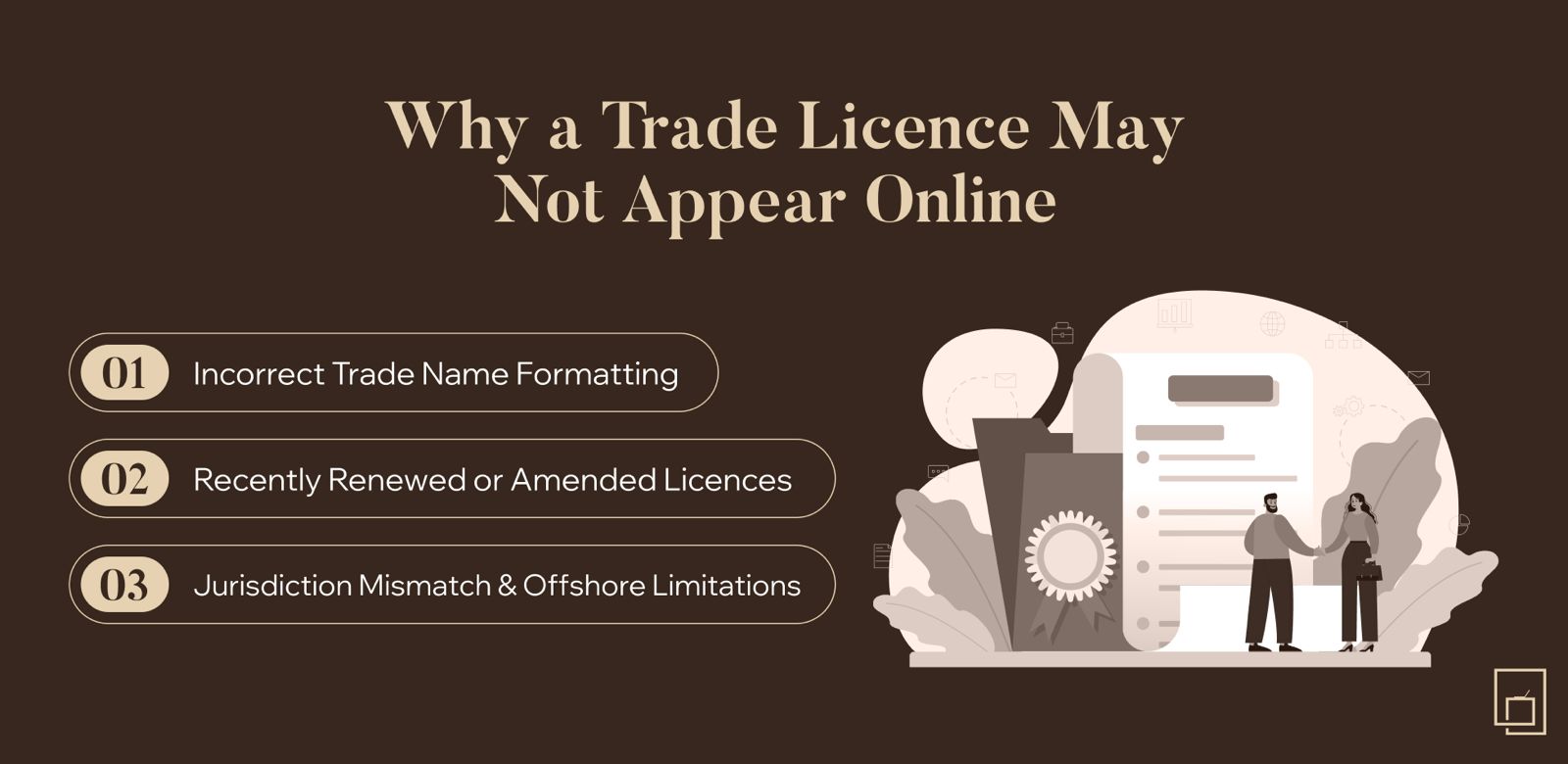
Incorrect Trade Name Formatting
Directory searches are highly sensitive to spelling variations. Companies operating under abbreviated names, English transliterations of Arabic wording, or legacy identities from before a restructure may not appear under the name initially provided. Searching “Al Faris” instead of the full registered title is a common example of a lookup returning nothing despite an active filing existing.
Recently Renewed or Amended Licences
Partner changes, activity revisions, and jurisdiction transfers trigger internal updates that do not always appear immediately across public platforms. A business renewed the previous day may still display an expired status while database synchronisation is underway.
Where timing is commercially sensitive, confirmation from the issuing regulator is generally more reliable than relying solely on a searchable portal.
Jurisdiction Mismatch and Offshore Limitations
Mainland systems do not include Free Zone filings, while Free Zone directories exclude Mainland entities entirely. Offshore structures incorporated through JAFZA Offshore, Ajman Offshore, and similar jurisdictions are intentionally omitted from public databases.
This is not a technical limitation. It reflects the confidentiality frameworks these jurisdictions operate under.
When Businesses Typically Conduct Trade Licence Checks

Before Vendor and Supplier Agreements
During procurement reviews, the priority is confirming that a counterparty is permitted to provide the goods or services being contracted. Reviewing the activity classifications on file helps determine whether the proposed transaction falls within the organisation’s approved scope. A firm can hold an active filing while still invoicing beyond its permitted categories.
During Banking and Compliance Reviews
UAE banks run automated compliance checks during KYC refresh cycles. An expired entry, even one recently renewed, can trigger transaction restrictions or account review flags while systems update internally. Payment processors apply similar controls during merchant onboarding.
An expired entry affects more than legal standing. Access to banking facilities can be interrupted within days, while restoring full clearance often takes longer than the renewal itself.
Before Commercial Leasing and Ejari Registration
Ejari, Dubai’s tenancy registration system, links directly to DET records. An expired filing or a business classification incompatible with the intended use of a property can prevent tenancy approval from proceeding.
Without Ejari registration, certain visa and banking procedures cannot move forward. Address eligibility should therefore be reviewed before lease documentation is submitted, particularly where Mainland incorporation requires a compliant office address from the outset.
What an Online Trade Licence Check Does Not Confirm
Online searches confirm filing status. They do not reflect tax exposure, financial condition, or sector-specific restrictions.
VAT and Corporate Tax status must be checked separately through the Federal Tax Authority’s TRN validation system. An entity may appear active while still carrying unresolved tax obligations that standard directories do not display.
Regulated sectors introduce further limitations. Actions issued by the Central Bank of the UAE, DHA, MOHAP, or SIRA sit outside standard DET and ADDED databases entirely. Ownership visibility is also limited, as publicly available shareholder details do not necessarily reflect ultimate economic control.

Key Considerations Before Relying on Public Licence Records
Public searches provide a preliminary reference point rather than a complete picture. For routine supplier checks, they are usually sufficient. Higher-value engagements, regulated sectors, and government procurement typically require additional review.
That often includes:
TRN validation
Chamber of Commerce confirmation
Review of corporate documentation
Banking reference letters where applicable
Checking Trade Licences Online in the UAE
The most common mistake in corporate verification is not the search itself but relying on the wrong authority or misinterpreting what the result shows.
Mainland and Free Zone companies are maintained through separate databases, while offshore structures remain outside searchable directories entirely. Recent amendments, jurisdiction transfers, and renewal updates may also take time to appear across published records.
When timing, procurement eligibility, or financial approvals are involved, confirming which regulator maintains the relevant filing is often just as important as the search itself.


Frequently Asked Questions
Can I check a UAE trade licence using only the company name?
What should I do if a company appears active but its Ejari has expired?
Does an active company status indicate financial strength?
Are branches of foreign companies verified through the same registries?
How long does it take for a renewed trade licence to appear online?