


Key Takeaways
Investor visa eligibility depends on the type of investment, ownership structure, and supporting documentation.
Mainland, free zone, property-linked, and Golden Visa pathways each involve different approval conditions and operational considerations.
Banking access and long-term operational stability are strongly influenced by how the company or investment is structured from the beginning.
Dubai continues to attract international investors, entrepreneurs, and property buyers at a scale few cities can match. Investor visas play a central role in that growth, particularly for those entering the UAE through company ownership or property investment.
What many guides overlook is how closely the process is tied to banking, compliance, and operational setup. Understanding those connections early often helps reduce delays later.
This guide covers the updated 2026 rules, the main visa pathways available, realistic cost considerations, and the factors that influence approval.
What Is an Investor Visa in Dubai?
This residency category is linked to qualifying investment activity rather than employment. It allows holders to live in the UAE through company ownership or approved property investment, provided the underlying investment remains active and compliant.
The visa is commonly issued through mainland companies, free zone entities, or qualifying property ownership. Unlike an employment visa, it places the applicant in the position of owner or shareholder rather than sponsored employee, which can influence banking access, regulatory approvals, and operational control.
This route is commonly used by entrepreneurs, shareholders, international founders, and property investors establishing a longer-term presence in Dubai. For applicants at the registration stage, understanding how business setup connects with the visa process helps reduce delays and avoid structural issues later.
Types of Investor Visas Available in Dubai
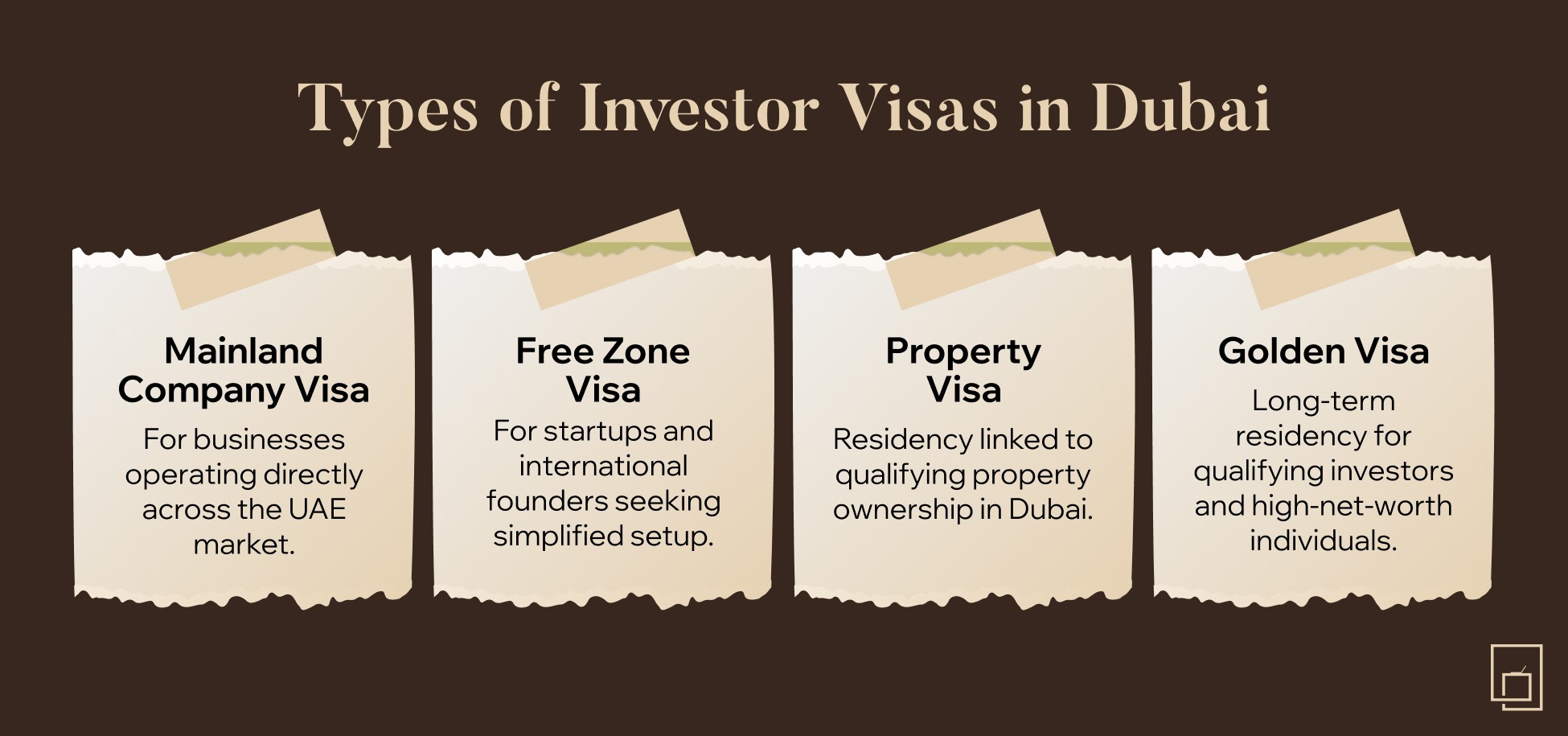
The investor visa framework in Dubai is structured around the underlying investment type, with each category involving different market access conditions and approval requirements.
Mainland Company Visa
A mainland investor visa is linked to ownership of a mainland-licensed business and provides broad access to the UAE market, including the ability to operate across all seven emirates and contract directly with government entities.
Typical requirement: Active mainland trade licence and registered business address.
Best suited to: SMEs, service providers, and businesses targeting the wider UAE market.
Free Zone Visa
Free zone investor visas are issued through the relevant free zone authority and linked to a company registered within that jurisdiction. Ownership is typically fully foreign-held, and setup is often faster than mainland registration.
Typical requirement: Free zone company registration and shareholder documentation.
Best suited to: Startup founders, remote entrepreneurs, and international businesses without an immediate need for direct mainland trading.
Property Visa
The property visa category saw significant updates in 2026. Under the revised rules, sole ownership of a property in Dubai can now qualify without a minimum property value threshold, while jointly owned properties require each owner to meet an individual ownership threshold independently.
Mortgaged properties are assessed based on the level of equity held rather than the total property value. Ownership arrangements and registration details should be reviewed carefully before purchase, particularly where visa eligibility is a consideration.
Typical requirement: Registered property ownership and title deed verification.
Important update: Final eligibility remains subject to approval by the relevant Dubai authorities and ownership verification requirements.

Golden Visa Pathways
The Golden Visa provides approval periods of up to ten years through qualifying property investment, business ownership, or financial holdings above the required threshold. Unlike standard investor visas, holders are not required to maintain continuous physical presence inside the UAE. Investors exploring broader visa options may also benefit from understanding how the Golden Visa framework applies in Abu Dhabi.
Typical requirement: Qualifying investment above the applicable threshold.
Best suited to: High-net-worth individuals, international founders, and investors managing interests across multiple markets.
Investor Visa Requirements in Dubai (2026)
Eligibility depends on the type of underlying investment and the authority handling the application. In most cases, applicants must provide proof of company ownership or property investment alongside valid identity and immigration documentation.
Common requirements typically include:
Valid passport
Trade licence or property title deed
Share certificates or Memorandum of Association
Passport-size photographs
Valid health insurance
Entry permit for non-resident applicants
Property investors may also need ownership confirmation from the Dubai Land Department. Requirements vary slightly between mainland and free zone applications, as well as between resident and non-resident applicants.
Once the initial application is approved, applicants complete a medical fitness test and Emirates ID biometrics before the final approval. Name inconsistencies, missing attestations, and ownership discrepancies are among the most common causes of delay, making document consistency critical throughout the process.
Step-by-Step Process to Obtain an Investor Visa
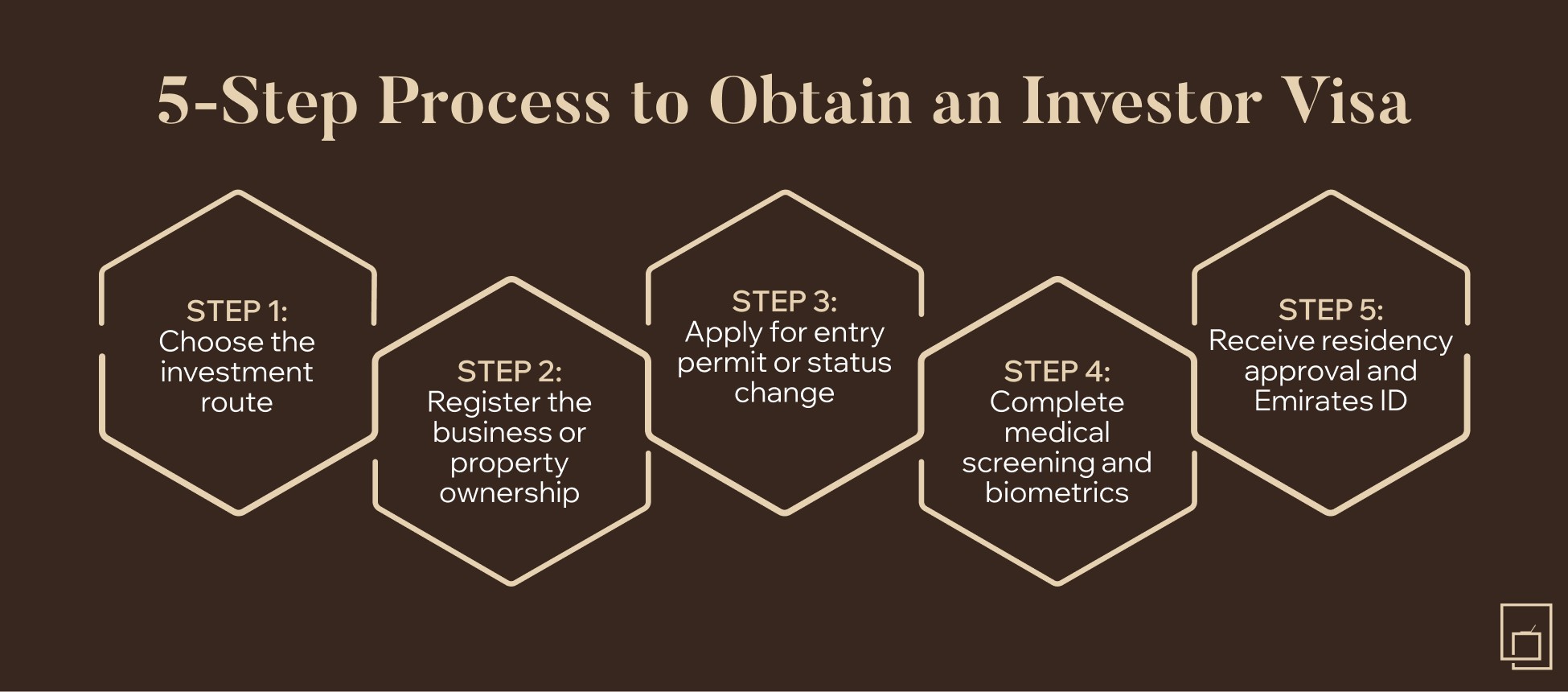
The process varies slightly depending on the investment type and issuing authority, but the overall sequence remains broadly consistent across mainland, free zone, and property-linked applications.
Step 1: Choose the Investment Route
Decide between a mainland company, free zone company, or property investment route. This determines which authority oversees the application, the documents required, and the conditions attached to the visa.
Step 2: Register the Business or Complete the Property Purchase
The trade licence must be active, or the property title deed officially registered, before the application can proceed. Ownership details must align clearly across all records.
Step 3: Apply for Entry Permit or Status Change
Non-residents apply for an entry permit before entering the UAE, while existing residents complete an in-country status adjustment. This often involves cancelling a previous employment visa before the new visa is issued.
Step 4: Complete Medical Screening and Biometrics
Applicants complete a medical fitness test and Emirates ID biometrics within the UAE as part of the approval process.
Step 5: Visa Issuance and Emirates ID Collection
Once approved, the residency visa is issued digitally and the Emirates ID can be collected. Straightforward applications are often completed within two to four weeks, while more complex ownership arrangements or property-linked cases may take longer.
Investor Visa Costs in Dubai
Costs extend beyond the application itself. Government charges typically include the entry permit, visa issuance, Emirates ID, medical screening, and immigration file fees, all of which remain subject to periodic revision. For company-linked applications, trade licence costs, establishment card charges, and workspace requirements also form part of the overall investment.
Additional expenses such as document translation, attestation, health insurance, and PRO coordination should also be considered during planning. Companies opening a corporate bank account alongside the application may face further administrative costs depending on the ownership arrangement and banking requirements. A registered address remains essential for most mainland and free zone licences, with private offices and virtual office arrangements serving different operational needs at different stages.
Common Challenges and Reasons for Delays
Most investor visa delays are linked to documentation, compliance, or business registration inconsistencies rather than the residency application itself.
Common issues include:
Name mismatches between passports and company documents
Missing attestations or incomplete ownership records
Trade licence activities that do not clearly match commercial operations
Higher compliance scrutiny in regulated sectors
Weak company structure or unclear ownership chains during banking reviews
Registered addresses that do not reflect genuine business activity
Residency approval also does not guarantee corporate bank account approval. Banks conduct separate compliance assessments based on the commercial activity, ownership structure, and overall credibility of the company. Understanding business bank account requirements early helps reduce delays later in the process.

How Business Structure Influences Investor Visa Approval
The structure behind the investment influences far more than visa eligibility alone. Mainland companies generally provide broader access to the UAE market, while free zone setups are often preferred for simplified ownership and faster registration. The right choice depends on the nature of the business, target market, and long-term operational requirements.
Business credibility also plays an important role during compliance and banking reviews. Consistent ownership records, aligned licence activities, and a registered business address in a recognised commercial district all contribute to how the company is assessed by regulators and financial institutions.
Why Investor Visa Planning Matters Beyond Residency
An investor visa is often treated as an immigration process, but in practice it sits within a broader business context. Decisions made during company formation can influence banking access, future expansion, family sponsorship eligibility, and how efficiently a business operates after registration.
Approaching the process as part of a broader operational strategy often helps reduce complications later. For many investors, the quality of the setup at the beginning determines how effectively the company functions after approval.



Frequently Asked Questions
How long is a Dubai investor visa valid?
Can family members be sponsored under this visa category?
What risks can affect approval or banking access?
Does residency approval automatically guarantee corporate banking access?
Can jointly owned property qualify for a Dubai investor visa?